Musings on writing, lessons learned by an aspiring professional, book reviews, movie reviews, an occasional t.v. show review, and unashamed opinion.

Wednesday, August 29, 2012

Caliban's War

I grew up reading science fiction.  Dune, Ender's Game, Jurassic Park... all sorts of sub-genres and authors.  I loved being transported to places that might be possible in humanity's future.  In high school my tastes changed and I became primarily a fantasy reader.  Mostly because I love history, and fantasy opened me to worlds in the past.  I've been getting back into sci fi, however, and I've read a lot of great authors in the genre this year--Alastair Reynolds, Peter F. Hamilton, Dave Wolverton, and John Scalzi. I found that I still love epic science fiction.  There is a lot of great stuff out there, but someone (or someones) always rises to the top and defines my taste of a specific genre.  For space opera--for all science fiction and its sub genres--this is the Daniel Abraham/Ty Franck team of James S.A. Corey.

Caliban's War is book two of The Expanse.  I had to wait to get into it because the audio version didn't release with the paperback a couple months ago (I'm too lazy to read).  I had a fun time with Leviathan (my review) but Caliban is where the story came into its own.  I can't wait to see what Abraham and Franck have in store for book three.

At the end of Leviathan the Universe as humanity knows it has changed.  An alien protomolecule is transforming Venus into Earth's greatest horror.  A tense truce exists between Earth, Mars, and the Belt, but the slightest provocation can set off the biggest war known to man.  And someone is kidnapping children on Ganymede.

James Holden returns as a point-of-view character, and three new-comers join him to continue this kick-ass story.  (Chrisjen Avasarala--a foul-mouthed grandma--is my favorite.)

There was a bit of a plot repeat from the first book that bothered me a little.  One of the characters in Leviathan is defined by his efforts to find a missing woman.  In Caliban one of the pov's spends the book looking for his daughter.  A small gripe, but I can't help that I felt like part of the book was retreading old ground.  Luckily, the two cases are quite different, and each takes the story and characters in different directions.  This for me was a small bump in an otherwise smooth ride.    

The last line of Caliban gave me chills.  Come to find out, Franck--who wrote it--said about the line, "...I think it's the coolest thing I ever did."  He obviously knew what a punch he was giving us, and how it would leave readers dying to get the next installment.  Trust me, it's awesome.  You'll have to read Leviathan first, though, to understand.

Caliban's War gets 5 out of 5 stars.  If you're any kind of sci fi fan, I highly recommend diving into this series.  We'll know in a couple of days if Leviathan took home this year's Hugo.  My fingers are crossed that it does.                    

Saturday, August 18, 2012

Concerning Breaking Bad's Walter White

If you're a writer and have yet to watch Breaking Bad, do yourself a favor and check it out.  You want to know how to write the perfect antagonist/villain?  Sink your teeth into this excellent t.v. series.  You can thank me later--after you've managed to climb out of the butt hole molded into your couch.

My purpose of this post isn't to review the show.  It's (Breaking Bad, that is) perfect--the best piece of television I have ever seen.  And that's saying something, when you consider how much I like Sherlock, 24, Everybody Loves Raymond, and The Walking Dead. (Yes, I just managed to sneak in my favorite shows in a post that has nothing to do with them--and I know you can't really consider anything about comparing them, since I've yet to review each on the blog.  Shut up.  Attempting to discover logic in my ramblings is futile.)  What I want to spit out is the reason why watching a high school chemistry teacher-turned-methamphetamine master chef is worth your time.  Walter White isn't a shining example of anything.  Do not do the things that he does!  However, if you want to learn how to write a villain watch (from the beginning of season 1) Walter's steep descent into evil.

I was trying to explain to my wife why I love Breaking Bad the other day. (I had just turned off the t.v. after a bleary-eyed ten episode marathon.)  This is what I came up with: I am able to sympathize (and the ability to sympathize with is the all-important key to a character's success) with Walter because of two things: 1. He is bad at being bad.  Walter White tries so hard to be the baddest dude around, but no matter what he does, he is always one-uped by the real bad guys. (One-baded doesn't quite make sense.) 2. He tries so hard to be bad yet still cares for his family, and so has some remaining ounces of humanity.  I despise everything else about Walter's character.  I won't give anything away, but he gets bad.  Evil.  Totally insane.  My wife isn't aware of this, but I was in tears (from shock, not empathy) at the end of a certain episode.  It is painful to see a man fall so far.  If it weren't for Walter's being such a terrible bad guy, I'd tell everyone to avoid the show.  The writers are brilliant, however.  They create perfect believability in Walter's journey into darkness.  It's pathetic, it's irrational, it's terrifying.  He is a character viewers and writers will not forget.

Seasons 1-4 are available on Netflix, and the fifth and final season is currently airing on AMC.  Another thing the people behind Breaking Bad are doing right is ending it.  All great stories have to end, and they are doing it at the perfect time--when the show is at its peak.

Wednesday, August 15, 2012

King of Thorns

Honorous Jorg Ancrath is back, this time with a throne.  He's as mean, as clever, and as unmovable as ever.  Four years have passed since the end of Prince of Thorns.  An army is gathering to dethrone Jorg and claim his land, but they will let him and his people go free if he yields.  However, King Jorg does not like doing what he is told.  

Mark Lawrence has delivered an ambitious sequel, giving us a deeper look into the mind of Jorg.  Jorg is one of the most interesting characters I've come across in fantasy, and I can't help but enjoy the time I spend with him--despite the helping of disgust that comes with the experience.  For me, a writer has proven himself when he can make me feel for his characters.  It ain't all lollipops and sunshine with 'ol Jorg, but he gets at me in ways I can't explain.  He is one superbly-imagined, nasty bastard.

As a novel, I have to say that I didn't enjoy King quite as much as Prince.  It comes down to the structure of the story.  In Prince, there was a much clearer narrative--Jorg was moving inexorably toward a specific goal.  The flashback sequences were more... relevant to the way the story was revealed.  I never felt lost or bored.  King, on the other hand, didn't have the focus, the flashbacks felt awkward more often than not, and I lost track of things a few times along the way.  By the end, everything came into focus--and I enjoyed the climatic scenes and reveals, but it didn't wash out the experience as a whole.  I think the biggest issue was that I always wanted to be in the "Wedding Day" sections of the story, rather than the "Four Years Earlier," and journal parts.  The threat on Jorg's doorstep was all I cared about.

That being said, I still really liked King of Thorns.  I recommend, of course, that readers start at the beginning of the series.  I feel that the third novel, Emperor of Thorns, is going to be epic.  I think that Mark Lawrence is going to be a power-house name in fantasy.  I think everyone should buy and read Jorg Ancarth's story.  There is so much emotion in the pages of this tale--you can't help but be pulled in.    

I'm rating King the same as Prince--4 stars out of 5.  Didn't enjoy it quite as much, but that's just because of my taste in structure.  The writing, characters, and depth are all on par with Prince, if not better.  So a 4 it is.  

-By the way, did the audiobook again.  Great voice and narration like the last book.

Wednesday, August 8, 2012

Earth Unaware

Orson Scott Card is back with another entry in his Ender series.  This time, however, he is taking us back to the first invasion of the Formics, before Ender was born.  He's teamed up with Aaron Johnston (who co-wrote the entertaining Invasive Procedures with Card a few years back) for this new trilogy and they do not disappoint.  If you love space opera with great characters, Earth Unaware is a book you shouldn't miss.

 Usually I like to write up my own synopsis of the book, but I'm feeling lazy right now, and it was a few weeks ago when I finished the book.  So here's the synopsis from the Tor website:


The mining ship El Cavador is far out from Earth, in the deeps of the Kuiper Belt, beyond Pluto. Other mining ships, and the families that live on them, are few and far between this far out. So when El Cavador’s telescopes pick up a fast-moving object coming in-system, it’s hard to know what to make of it. It’s massive and moving at a significant fraction of the speed of light.
But the ship has other problems. Their systems are old and failing. The family is getting too big. There are claim-jumping corporates bringing Asteroid Belt tactics to the Kuiper Belt. Worrying about a distant object that might or might not be an alien ship seems…not important.

They're wrong. It's the most important thing that has happened to the human race in a million years. This is humanity's first contact with an alien race. The First Formic War is about to begin.
There you have it.  The characters are great, the setting interesting, and the conflict quick and tense.  It reminded me a lot of Leviathan Wakes--which I reviewed not too long ago--though not quite as good.  I think it's the best science fiction novel Card has written in quite some time, and I'm excited to see where the series goes.  It did end abruptly, but I was satisfied with where things were left.  
The audio was a bit annoying.  Card's books typically have a full cast--different narrators for different characters--but EU was missing the familiar voice of Scott Brick.  His usual narrator, Stefan Rudnicki, is present but doesn't narrate any of the main characters.  I wasn't a fan of the two narrators that took up most of the book.  Would have been better to feature Rudnicki and Brick with the others doing for the minor characters.
Earth Unaware gets 4 stars out of 5.  I highly recommend it if you're an Orson Scott Card or space opera fan. 
P.S. Mr. Card, I love ya, man, but please finish the Alvin Maker series before starting another series!!

Monday, August 6, 2012

The Dark Knight Rises

Finally, the movie I've been waiting all year to see has arrived!  And folks, it does not disappoint.  In fact, this final Nolan/Bale Batman film is a slam-dunk.  If you haven't seen it yet, get your butts to the theater, and then go seven more times.


I've been a Batman fan for a long time.  I can still remember the Christmas I got a Batman action figure and Bat-mobile.  The toys were based on Burton's films.  The Batman had a string that pulled out of his utility belt.  It was awesome.  I remember being obsessed with Batman Forever, and defended it as the best of the films for a long while. That was until Batman Begins, anyway.

It shouldn't come as a surprise that I loved each of Nolan's films.  Batman Begins proved that comic book movies didn't have to suck.  (Looking back, I think every Batman movie before Begins sucked.  I bought into them as a kid, but come on, they're lame.)  The campiness of previous films was gone, the hero was seriously disturbed, and the villains were as realistic as could be hoped for.  I was one of the doubters and never saw the film in the theater.  (I'd been stung too bad by the horrendous Batman and Robin, which even as a kid I hated.)  When I got around to seeing it on dvd I almost pooped my pants with joy.  Then The Dark Knight hit theaters, forever changing the super-hero genre.

The Dark Knight was a tough sequel to top.  Heath Ledger gave the best performance of his carrier as the Joker, and easily slaughtered every other comic book movie villain.  But it wasn't just Heath that make TDK such a success.  Every minute of that film was full of tense, interesting conflict, that tested Batman to his limit.  TDK was a tough one to beat, but The Dark Knight Rises did indeed do so.  Go see it and tell me I'm wrong.

Sunday, July 29, 2012

The Yard

In my last post I mentioned that a book cover rarely sales me on a book.  I must be turning into a big fat sucker lately--or not lately... I usually don't need much of a reason to buy new books--because another cover caught my eye at the book store, and I purchased the book (on audile--sorry B&N).  If you're a fan of Sherlock, you'll enjoy reading or listening to The Yard--the debut novel by Alex Grecian.

The Yard tells the story of several detectives part of Scotland Yard's murder squad.  The setting is 1890's, shortly after the last of the Ripper murders.  London is still reeling from the horror of "Saucy Jack," and the citizens are all too willing to distrust the police's ability to protect them.  When more mysterious murders start happening--one of the victims a murder squad detective--everyone assumes the Ripper has returned.

The characters are fictional, though based on several real-life detectives.  One character--a doctor--is on the cutting edge of CSI theory, and amazes the detectives of the Yard with his analytical and deductive abilities.  It's easy to assume he is the Sherlock of the book, but the doctor doesn't do the actual investigating.  This is left up to two detectives, one an old-school veteran, the other a newbie.  Together, the newbie and doctor give us the Sherlock nod.  Also, there is a beat cop unwilling to let a case go unsolved.  Each of the threads are woven into each other by the end, if only a little too conveniently.  I was completely satisfied by book's end, though, despite a few hiccups.    

There were a few points of writing style that got on my nerve.  For example, when the point of view for the villain is given (third-person limited for the most part), he is referred to as the bald man.  Pointless, since no one would think of themselves this way, and if a name was given he would be as equally unknown to the reader as he is as the bald man.  His identity is revealed so early in the book that it is completely useless to do this little trick.  It was like Grecian had been told to hide his villain's identity from the reader to create suspense, but then decided halfway through to just tell us who the dude was.  Thing is, the suspense came from knowing who the villain was--seeing how close he was to the detectives--and seeing how it all played out with the police on his trail.  If the suspense was supposed to be not knowing who the villain was, there never should have been a point of view for him.    One other thing that seemed odd were a few interludes sprinkled randomly throughout the narrative.  The interludes gave a brief window into the past of three characters--one when a character was a child, and the other two only a few years before the beginning of the story.  I understand why the interludes existed--they are there for an extra view of the main characters.  Problem was that they didn't actually add anything to the narrative.  The information given could have easily been done with a simple paragraph of exposition for each.  I would have liked the interludes to matter more to the tale being told, and maybe a bit more structure as to how they were presented.

I enjoyed The Yard quite a bit.  The narration was excellent, the characters were fun, and industrial London is always an intriguing place to visit.  I would have liked more mystery, and a bit of a darker flavor, but all in all, I can say that it is a novel worth your time.  A sequel is scheduled for next year.

The Yard gets 4 out of 5 stars.    

Thursday, July 12, 2012

Prince of Thorns

It is very rare that a book cover will entice me to read a book.  I'm much more of a word of mouth/review-reader buyer.  Illustrations are nice and all, but I want someone to tell me why they liked a book.  For whatever reason, this wasn't the case with Mark Lawrence's debut novel.  The marketing department succeeded this time, however, and I knew I had to read Prince of Thorns because of a pretty cover.  I'm glad I did.  It was an excellent novel.  One every dark-fantasy fan should read.


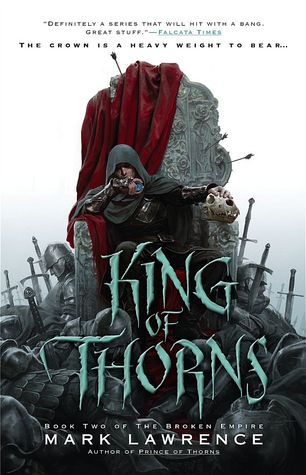
Okay, I have to amend the above statement... just a bit.  See, beginnings are everything--I had to hook you with my opening.  Now that I have, I'll be honest.  The cover for Prince of Thorns never did it for me.  I saw the book on the shelf at Barnes and Noble, and never even bothered picking it up--because the illustration is too... I don't know... graphic-novelish for my taste.  (Not to bag on graphic novels or their readers--I've just never gotten into them.)  But I did say that a cover caught my eye, which is why I put the cover for book two, King of Thorns, up as well.  I haven't yet read KoT, but holy crap!  That is an amazing cover!  Without knowing a thing about Lawrence and his series, I knew I had to read it after seeing that badass owning the throne on a pile of corpses.  

So the cover for book one didn't catch me, but the story and characters did.  The tale Lawrence spins is at times terrifying,  and then beautiful.  I almost feel guilty for liking the main character, Jorg, so much, because he is one hard bastard.  It's quite refreshing, though, to read about a character who is so honest--so brutal because his world has made him so.  In my mind, Jorg compares to Jaime Lannister from GRRM's series (Jaime is by far my favorite character in Martin's world).  Both are the toughest dogs in the yard, and both  do terrible things for gain.  Like Jaime, though, Jorg is deeper than his outward actions.  It takes knowing Jorg's past (which we receive in flash-back chapters) to understand him.  I don't know that understanding him means sympathizing with him, but I believed his arc because of his history.  Pulling this type of character off is no easy feat.  Mark Lawrence knows his business.  I can only stand with my mouth open that PoT is this guy's debut.

Prince of Thorns is the tale of Honorous Prince Jorg of Ancrath, told in his own words.  A brutal tragedy shapes his life at the young age of ten, and he sets off on a path of fire and blood to carve out his destiny in a post-apocalyptic Europe (I think about a thousand years in the future).  The setting is very medieval, with hints of our current civilization in decay.  There are sorcerers, necromancers, mutant-monsters, knights, whores, and blood.  

PoT reminded me of two series while I listened to it (besides Jorg's likeness to Jaime Lannister).  There's a lot of similarities with Stephen King's Dark Tower series (at least the first book, Gunslinger, anyway), and Bernard Cornwell's Saxon series.  The world in PoT reminded me of Roland Deschain's, while Jorg's telling of his story made me think of Uhtred of Bebbanburg.  Both are great comparisons to me.  If you're a fan of either series, you'll probably enjoy Lawrence's work.  

Well, I guess that's enough gushing.  You'll hear more from me on this series and author soon after I give a listen to book two.  (Here's hoping the audio is out the same day as the hardcover--only a couple of weeks away.)  Prince of Thorns gets 4 stars out of 5.  Go read it!   

-Also, check out Lawrence's post about how he became a published author.  It's quite inspiring.